Completion requirements
4. Various types and applications of AI in Education
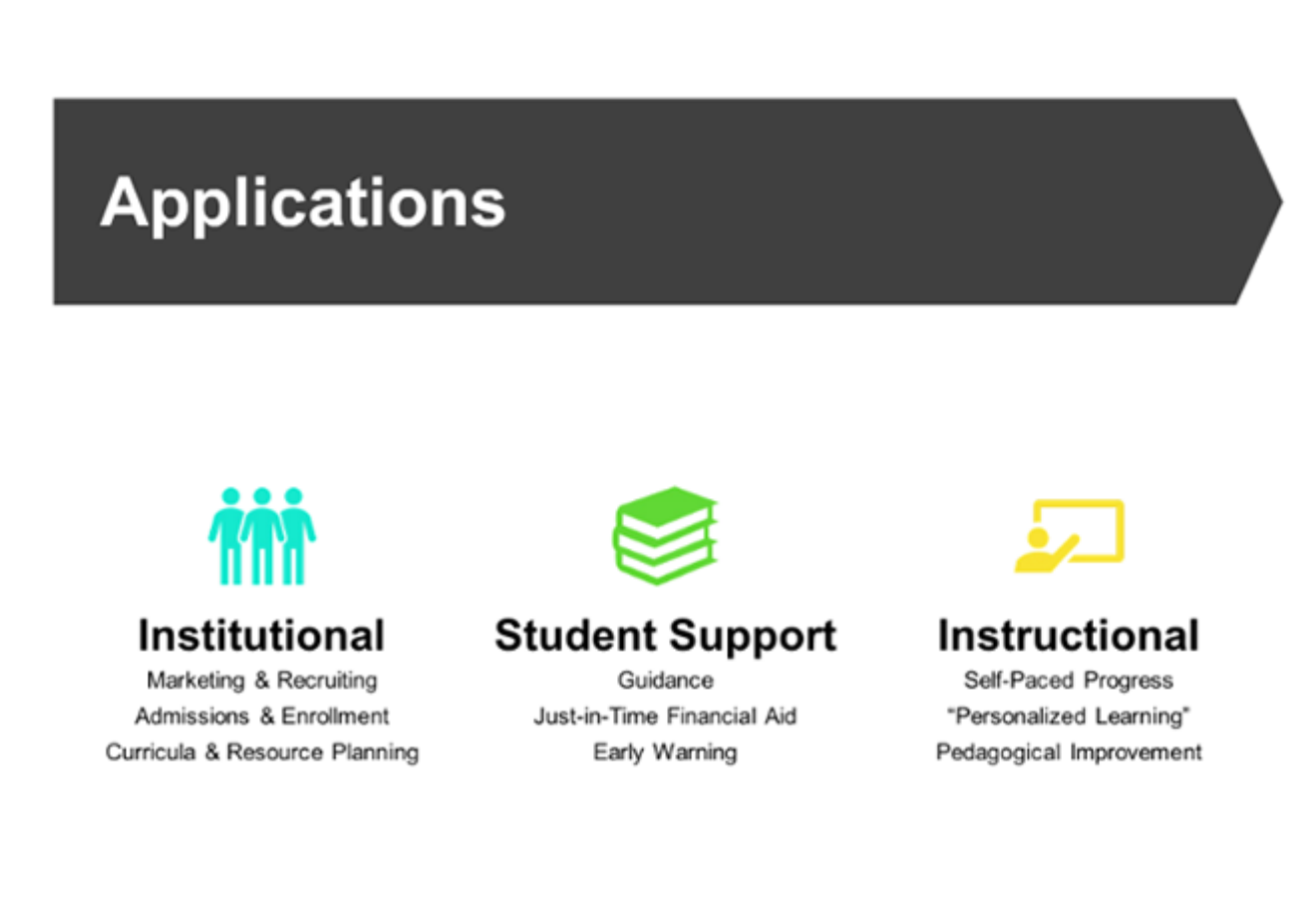
There are different possible areas of application of AI in education. Zeide (2019) makes a very useful distinction between institutional, student support, and instructional applications.
Before we talk about the applications let's read and watch little about AI.
AI is all about Machine Learning, Natural Language Processing, and Computer Vision enabling brilliant innovations in education. Not to be scared looking at these phrases. To simplify machine learning given below is an excellent video created by AI4Teachers is licensed under CC BY 4.0
What is Machine Learning by AI4Teachers is licensed under CC BY 4.0
Currently there are many applications like adaptive learning systems for example, these systems are capable of supporting teachers recommending appropriate teaching strategies based on student performance, automated assessment tools like automated grading mechanisms, feedback providers which may provide students guidance when they are confused in their work or they provide assistance to students in completing assessments by providing respective resources that help them in their assessment questions, virtual tutoring systems which may provide teaching content to students while supporting them with adaptive feedback and hints to solve questions related to the content, also paralally working on detecting students’ difficulties when working with the content or the exercises, speech recognition tools to support language learning etc. making teaching learning environments more robust by reducing the time consumption and providing teachers their valuable time to utilise in betterways to engage students in more meaningful ways. (fromTeaching in a Digital Age: Third Edition - General Copyright © 2022 by Anthony William (Tony) Bates is licensed under a Creative Commons Attribution-NonCommercial 4.0 International License)
Educators can utilise machine translation tools to create multilingual resources, communicate with non-native speakers, and support diverse students in language acquisition.
While these tools are powerful tools, it is essential to review and refine the translations, especially for grammar, bias, cultural nuances and domain-specific terminology, to ensure accuracy and appropriateness.
Google Translate, Copilot, ChatGPT, and DeepL are few examples of AI tools used for machine translation and other language-related tasks.
- Have you ever tried https://translate.google.co.in/Links to an external site. to translate Webpages or Documents?
Sometimes these technological advancements may give errata, for example in a classroom if a system is predicting students behaviour and recommending learning path, it's teachers responsibility to evaluate the machines prediction and decission and act accordingly. Machines may not be always correct. Do you agree?
For example if a student is using a language learning app and by mistake gave few wrong answers or may be tired that day aand gave wrong answers and the app may start giving simpler questions assuming students need easier questions as their level of understanding is low, this makes the learning journey not only boring but may demotivate student to go further. Here the machine could not account external factors.